Diane Ravitch discusses the pitfalls of standardized testing. What is fascinating are the educational results from Finland. Globally, Finland ranks number 2 in math, science, and literacy. Not a single standardized test is given to students. A graduating student who applies for college will take a final exam at the end of his or her elementary education. That’s it.
In contrast, American spends billions in standardized testing from grades K-12. Parents, boards, and colleges are obsessed with testing. Teachers are assessed based on the testing results produced by the students. Teachers are fired and schools are closed. The only persons not responsible for testing are the students, test writers, and the Department of Education. Guess who writes the general classroom tests in Finland? The teacher. Imagine that.
Here is the link:
“Artificial manures lead inevitably to artificial food, artificial animals, and finally to artificial men and women.”
Sir Albert Howard, An Agricultural Testament
Well, the goal was to finish the table by Thanksgiving. Right now the table is in the kitchen and the turkey is still in the oven.

We had to carry the table into the house in two pieces, and it probably weighs a good 250 lbs.
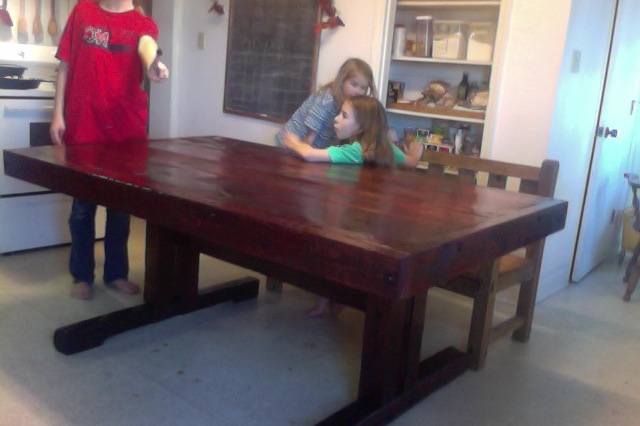
I picked a red oak stain because most of the wood is oak and is from old tobacco barns. The wood that I have seen from tobacco barns has a deep red burnt look, so I figured the red oak stain was a good fit. I put one coat of polyurethane on it, but I will more than likely add another coat after Thanksgiving. For now it is done.

Happy Thanksgiving, 2011.

My daughter Gavriel decided to start helping me, and we finished the sanding last night.

I could not get all of the rolls and unevenness out in the timeframe I allotted myself (by Thanksgiving), but I figure that is what makes it a rustic table anyway.

I also tried to remove any large cracks with wood filler. However, my problem is that as soon as I see one crack, I very quickly begin filling every crack. If wood filler is done well and sanded correctly, it can improve the final look. But if it is done poorly and too much of it is noticeable, it can be a distraction from the beauty of the wood and ruin a project. I tried to find the right balance, but I do have a time frame (excuse #1) and I did have my most impatient daughter helping me who was far to anxious to start staining last night (excuse #2).

Here she is trying to lift the table.

Writing is not merely about writing, and grammar is not taught simply to make better writers.
I recently spoke with a parent who also teaches English grammar, but at the local public high school. We lamented the lack of a rudimentary knowledge concerning basic English grammar among our students. She relayed to me what she tells her students, how they need to know basic grammar if they wish to secure successful careers.
It is true that employers want employees who can write a memo or speak with customers using correct English grammar. “But, that is not the only reason we teach grammar,” I replied. We also teach grammar to train students how to think. The order of grammar orders our thoughts. We teach grammar to in-form the mind and to cultivate habits of right thinking that we might think rightly.
Well, I have made some progress. There are 8 pieces that make up the table top, 4 – 2 x 6’s and 2 – 2 x 12’s. I had to glue and dowel them together by twos before connecting them as a single piece. Considering the years (at least 20) they sat in Mr. Worthington’s barn, they were a bit warped. It took some careful clamp work, but I managed to get most of the bends out.


It is hard to tell with these pictures, but I have a good bit of plane work to do.
I finished the legs tonight, and I am pretty happy with them.


Starting tomorrow, I will attach a 2 x 4 border to the table top. After that, I will need to plane and prep the pieces for varnish, and then put it together. I am hoping to have it done this weekend.
My first task, after roughly sketching a plan (see below), was to find the lumber. Not as easy as you might think.

I went to Lowes, but that was a waist of time. There was not a bit of rough cut lumber, and I figured there wouldn’t be, but there wasn’t any untreated 4 x 4 either. Every piece of lumber above the 2″ thickness scale was pressure treated, and unless I wanted to poison my family or any guest, I would need to seek out an alternative.
So I asked the guy wearing an apron. Never trust guys wearing aprons. He didn’t have a clue, though he did mention trying another place across town. Well, they didn’t have anything either except $5.60 per linear foot douglas fir. I needed 24 feet. That’s $134 just for the 4 x 4. I don’t think so.
So I returned home, after several hours of driving all over Greenville NC, and drove across the street to Mr. Worthington’s house. Now I live on Worthington Rd., and as you may surmise, his family farmed this entire area. Mr. Worthington is, in our nearest estimation, in his late 80’s or maybe even 90. He’s got to be close. He is very active. Mr. Worthington mows his pasture every other week, and what is embarrassing is that his yard looks 20 times better than my yard and he tends it himself.
Well, I wandered over and asked if he had any old lumber laying around. In his very strong and unclear NC accent, he says, “Yeah, I g’t some o’er thair. Com’n o’er an let’s take a look.” That’s as close as I can get.
We walked over, and he had a pile of rough cut lumber that was cut by a home mill 30 to 40 years ago, and was used on their old tobacco barns. It was beautiful, but covered in dirt and mouse droppings.
After bringing a few select pieces home, I started planning. I discovered very quickly that I pulled a real 2 x 8 x 13′ piece of solid oak. That piece alone is worth a pretty penny. I offered to pay, but Mr. Worthington insisted that I take whatever I needed for free. I will certainly give him and the misses a gift card to their favorite restaurant or something.

The beauty of this “rustic” lumber is that no two pieces are the same. This will create a unique table, but it requires a lot of work, or at least a willingness to settle for imperfections.

My goal is to finish before Thanksgiving.
I recently saw a rustic table on another blog that inspired me to finally build the dinning table I have been talking about for years.
The table was a simple 4’x6’x32″ table made of 2 x 12 and 4 x 4 that I could pick up from my local Lowes. Not quite.
I asked my wife what she thought. That was the first detour I encountered. The second was trying to find untreated 4 x 4.
My wife graciously opened our new Williams and Sonoma mail catalog and showed me a table that required twice the wood and effort to make. The plans for the other table were already mapped out. Now I would have to start from a picture.
“Well, can’t you just get bigger wood, and put it together?” Uh, it’s not that easy.
To prove just how difficult it is, but my willingness to honor my wife, I am taking on the task.
 Wrangling